KARAT CARD | July 1 - July 14 2023
KARAT CARD | July 1 - July 14 2023
Increased qualified leads by 200% for the Karat Card
Increased qualified leads by 200% for the Karat Card
OVERVIEW
OVERVIEW
Karat earns revenue from interchange fees on the business credit card product. Our goal was to grow the number of new cardholders to unlock more spend.
Less than 10% of applicants complete their application, and even worse, not all completed applications qualify for the card, resulting in wasted effort for all parties involved.
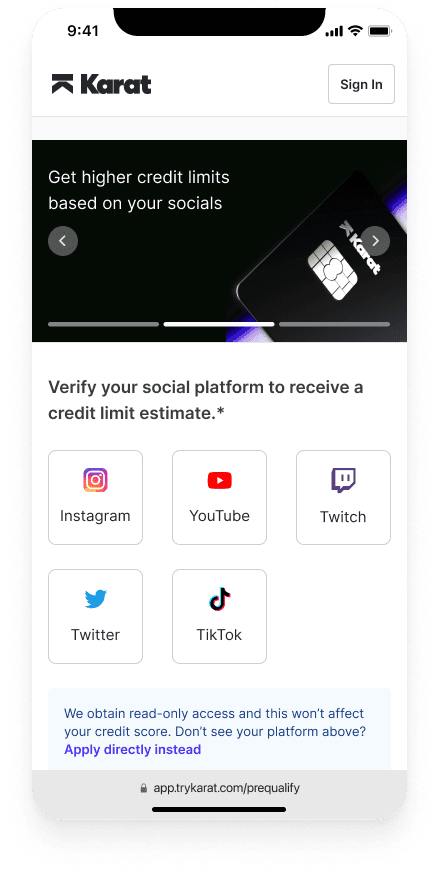
As part of our Series B announcement, we launched a pre-qualification flow that informed the applicant in just one-click whether they qualified for the Karat card. This resulted in a 200% increase in qualified leads.
Karat earns revenue from interchange fees on the business credit card product. Our goal was to grow the number of new cardholders to unlock more spend.
Less than 10% of applicants complete their application, and even worse, not all completed applications qualify for the card, resulting in wasted effort for all parties involved.
As part of our Series B announcement, we launched a pre-qualification flow that informed the applicant in just one-click whether they qualified for the Karat card. This resulted in a 200% increase in qualified leads.
MY ROLE
MY ROLE
Product designer — Research, design, prototyping, testing
Product designer — Research, design, prototyping, testing
TEAM
TEAM
1 Product Manager
1 Engineer
1 Product Manager1 Engineer
HIGHLIGHTS
In one-click, you would know if you qualify for the Karat card
In-app onboarding flow
In-app onboarding flow
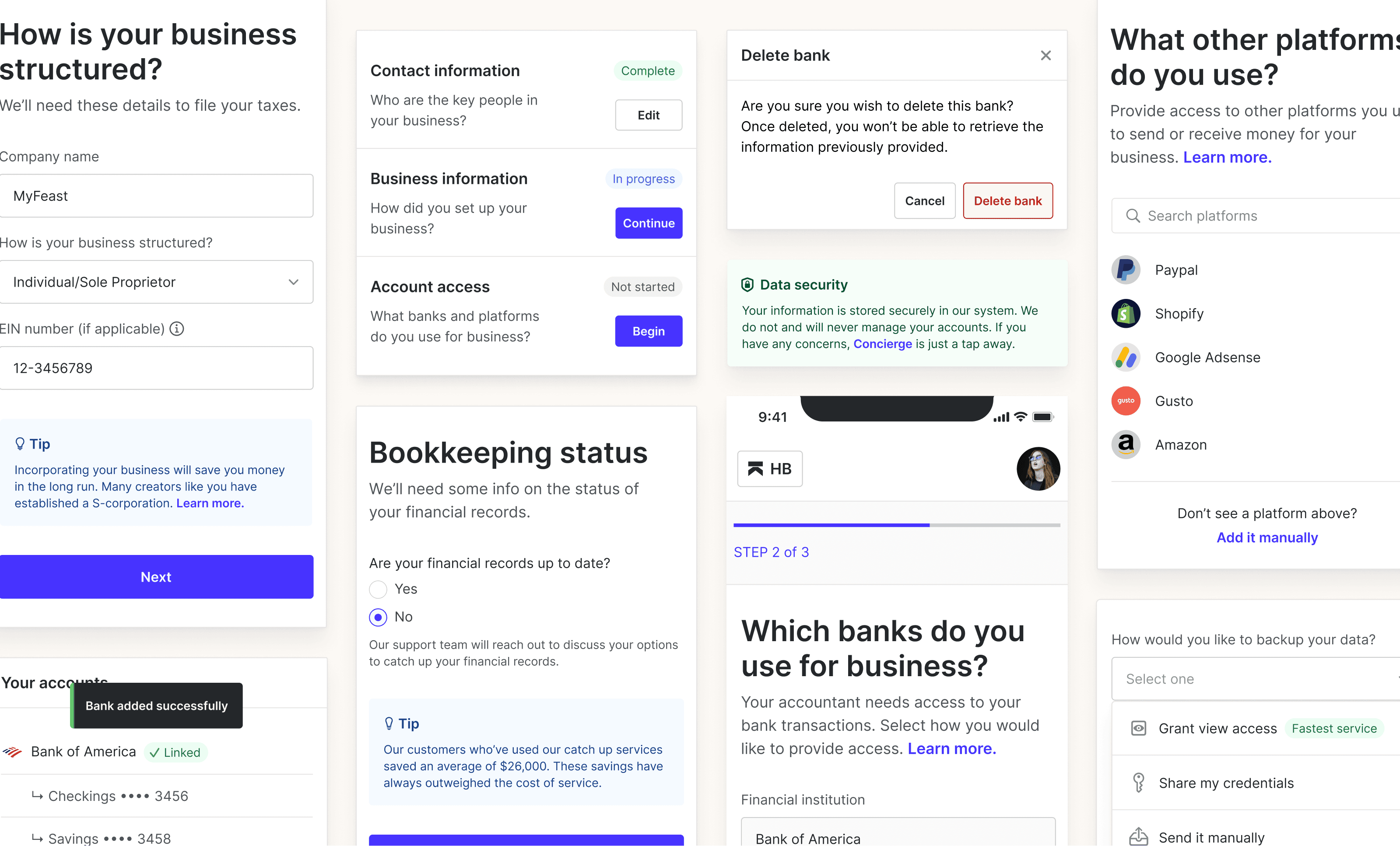
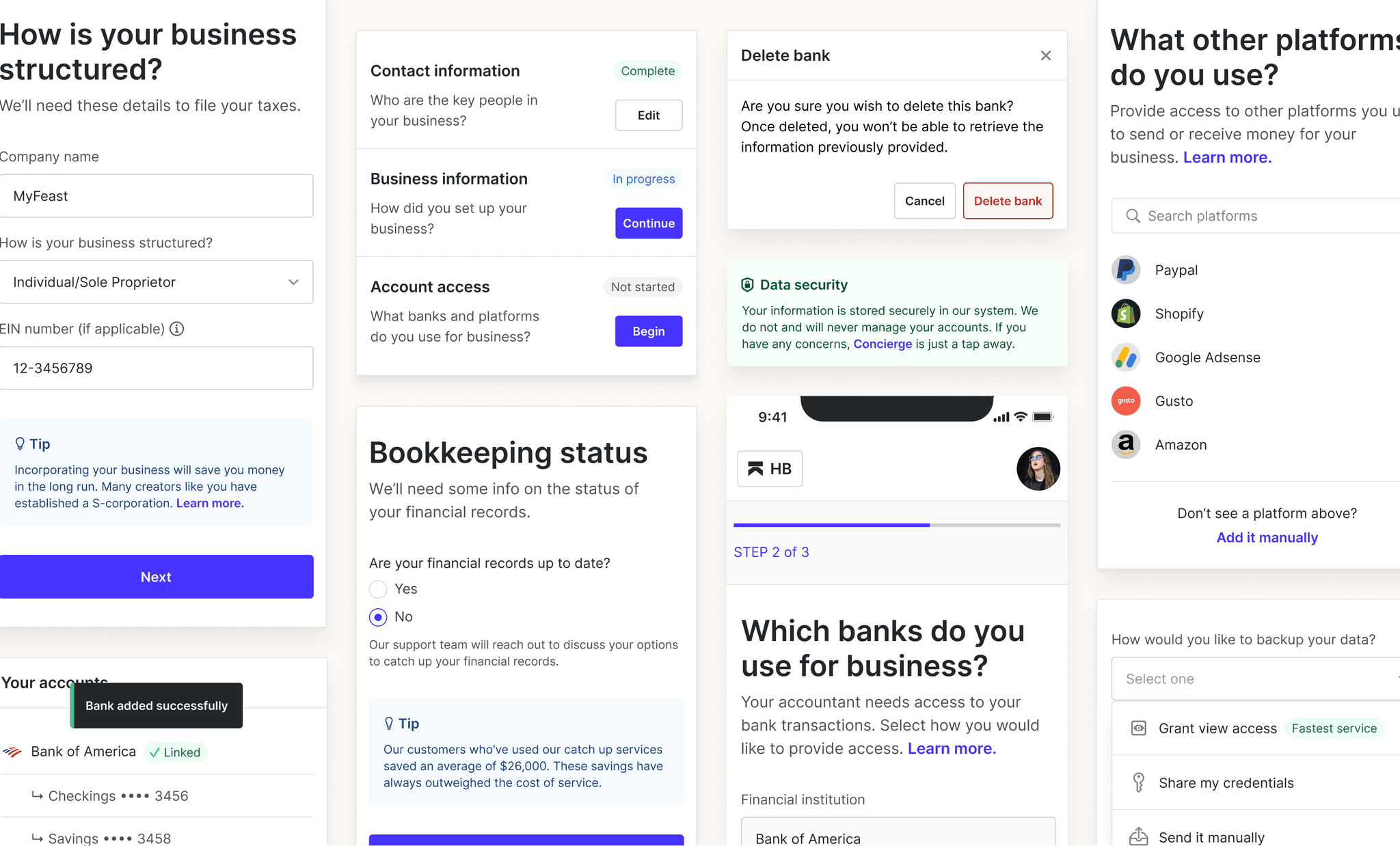
Previously, customers filled out forms manually. Now they can provide their information directly within Karat which allowed us to personalize the experience, simplify questions and make it easy to track progress.
Previously, customers filled out forms manually. Now they can provide their information directly within Karat which allowed us to personalize the experience, simplify questions and make it easy to track progress.
Customer management system
The answers from the onboarding flow were synced and displayed within a dashboard visible to accountants. This made it easy for accountants to track progress, centralize information, and get notified instantly which saved them time from having to manage it manually.
Customer management system
The answers from the onboarding flow were synced and displayed within a dashboard visible to accountants. This made it easy for accountants to track progress, centralize information, and get notified instantly which saved them time from having to manage it manually.
HIGHLIGHTS
We built a two-way platform to seamlessly share information between customer and accountant
DISCOVERY
Back-and-forth communication is a time consuming aspect of an accounting practice, particularly during the onboarding process
From market research and accountant interviews, the most time consuming part of accounting wasn't actually the accounting itself, but rather, it was the extensive communication needed to get there. This problem was exacerbated when onboarding new customers because of the sheer volume of information needed upfront.
I proposed that we could scale Karat Books by setting up a two-way system, allowing us to sync both customer and accountant information in real-time. We would start with the onboarding problem by reducing the back-and-forth communication consuming both parties' time.
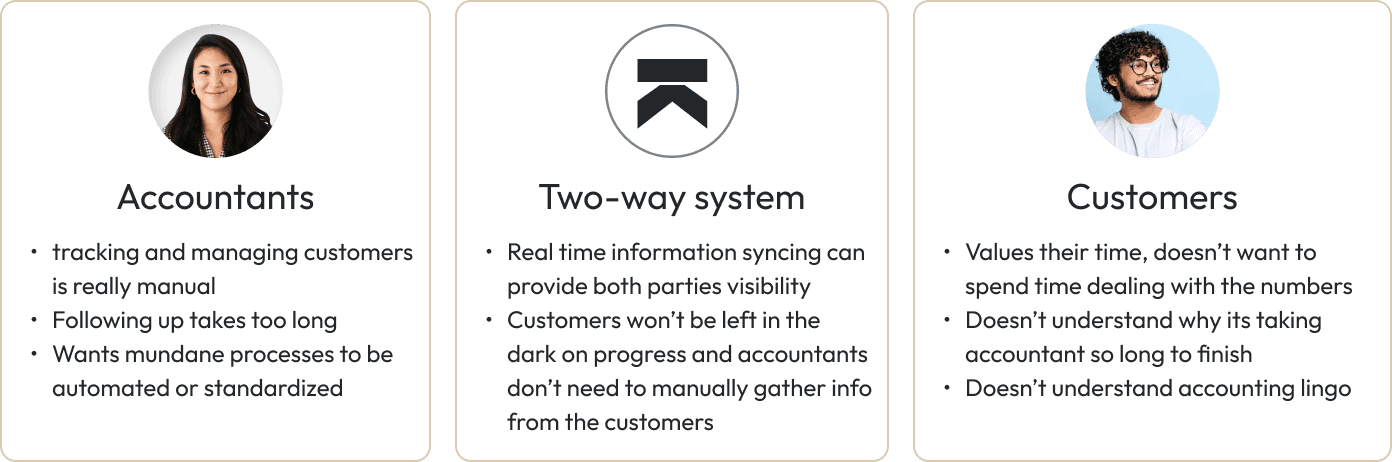
The entire accounting process involved a lot of redundant back-and-forth communication between customers and accountants. We needed a solution that could facilitate information exchange in a seamless way.
The entire accounting process involved a lot of redundant back-and-forth communication between customers and accountants. We needed a solution that could facilitate information exchange in a seamless way.
Customer management system
The answers from the onboarding flow was synced in real-time and displayed within the customer management system. This made it easy for accountants to track progress, centralize information, and receive notifications when their assistance was needed.
(Mark are you cool with me featuring this? lol)
“I think many of us have some vague idea about the path forward, but you describe the landscape, strategy, and v1 implementation with great clarity.”
— Mark Ury (Head of Design)
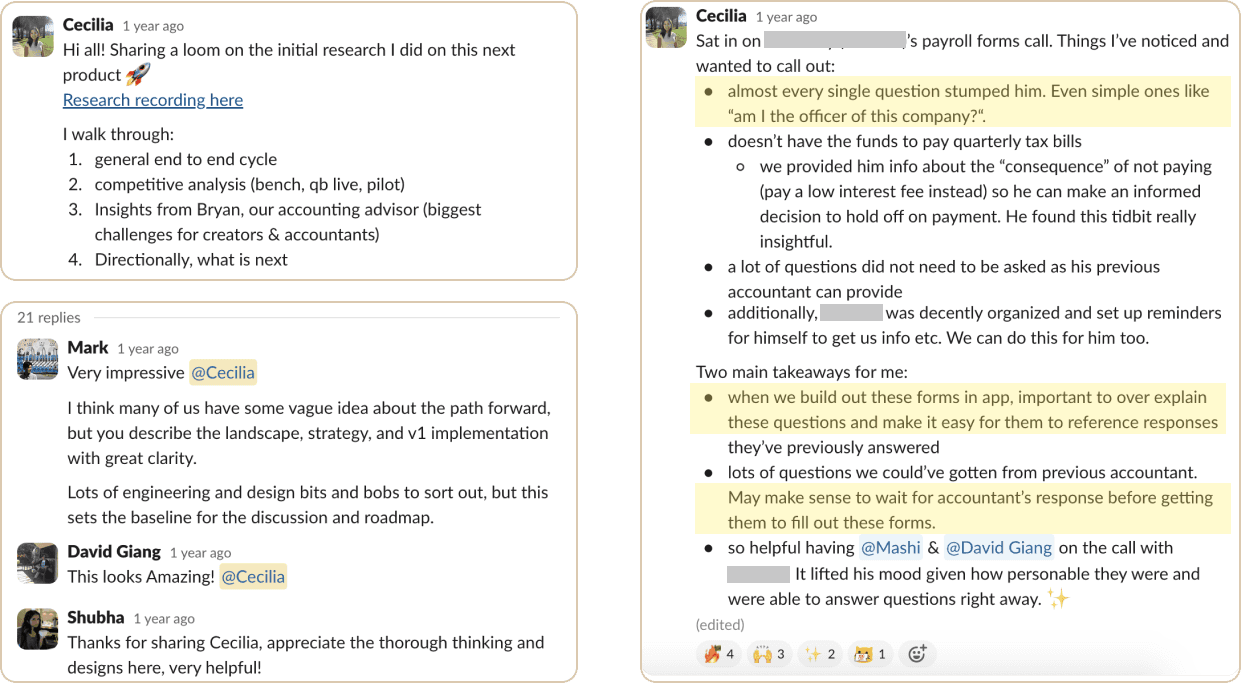
(Mark are you cool with me featuring this? lol)
“I think many of us have some vague idea about the path forward, but you describe the landscape, strategy, and v1 implementation with great clarity.”
— Mark Ury (Head of Design)
(Mark are you cool with me featuring this? lol)
“I think many of us have some vague idea about the path forward, but you describe the landscape, strategy, and v1 implementation with great clarity.”
— Mark Ury (Head of Design)
DISCOVERY
Back-and-forth communication is a time consuming aspect of an accounting practice, particularly during the onboarding process
From market research and accountant interviews, the most time consuming part of accounting wasn't actually the accounting itself, but rather, it was the extensive communication needed to get there. This problem was exacerbated when onboarding new customers because of the sheer volume of information needed upfront.
I proposed that we could scale Karat Books by setting up a two-way system, allowing us to sync both customer and accountant information in real-time. We would start with the onboarding problem by reducing the back-and-forth communication consuming both parties' time.
ONBOARDING FLOW EXPLORATIONS
Personalization instantly reduced customer onboarding time
We requested a lot of redundant information from customers which significantly delayed onboarding time. I designed a more personalized approach that helped customers provide the necessary information to accountants faster and more efficiently. As a result, we reduced the number of questions we asked most of our customers by approximately 33%.
ONBOARDING FLOW EXPLORATIONS
Personalization instantly reduced customer onboarding time
We requested a lot of redundant information from customers which significantly delayed onboarding time. I designed a more personalized approach that helped customers provide the necessary information to accountants faster and more efficiently. As a result, we reduced the number of questions we asked most of our customers by approximately 33%.
Customers needed to feel the urgency to finish onboarding
After launching the onboarding flow, customers still didn’t prioritize finishing it. They became more motivated once it was clear to them that it was delaying their financial reports.
We found the right balance between proactive reach out vs being seen as spam. We automated initial communication, and if customers were still unresponsive, our support team provided that essential human touch.
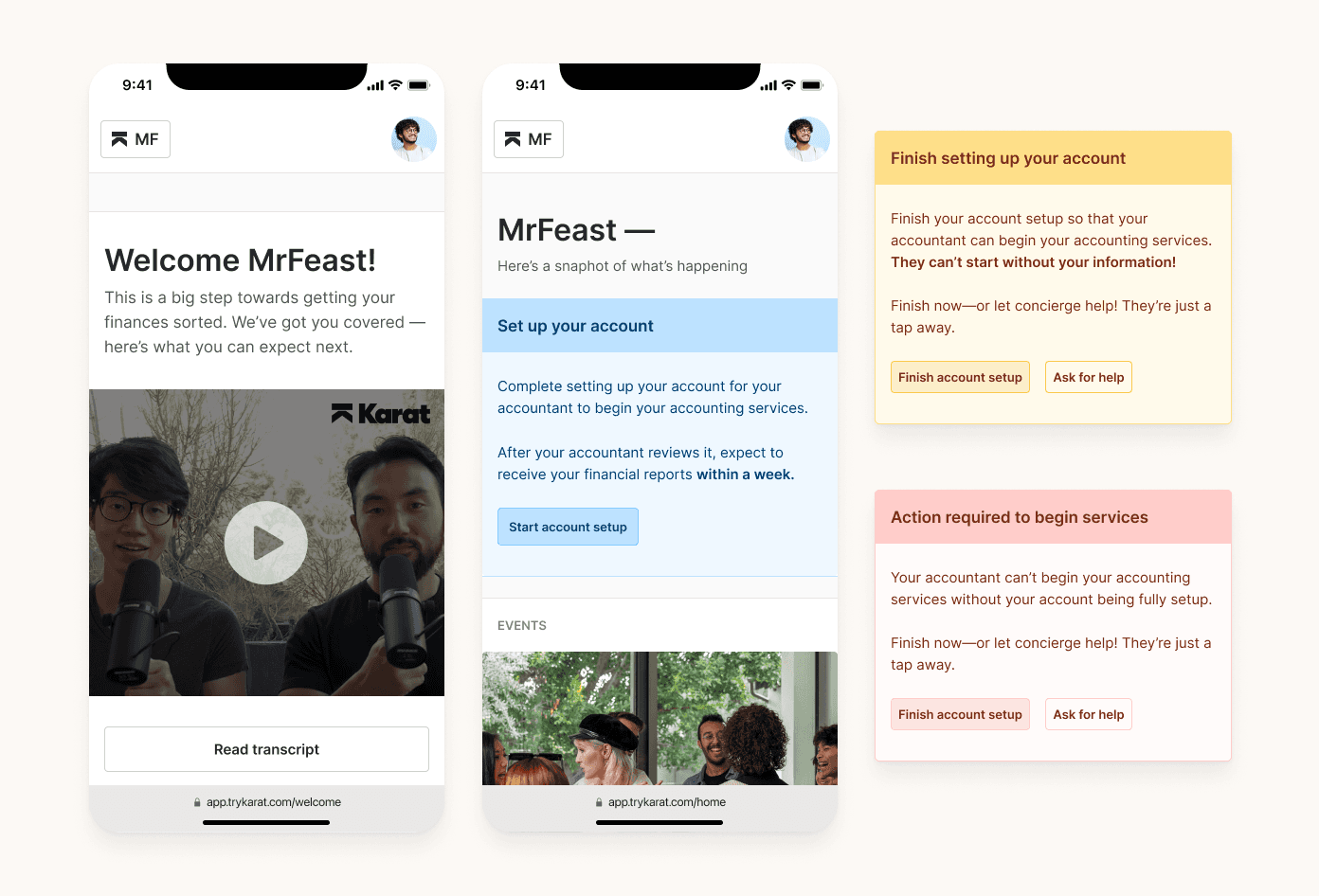
A welcome video from our co-founders added a personal touch to help emphasize the importance of onboarding. We also automated reminders via app, email and text. This reduced accountants’ time having to follow up each time.
A welcome video from our co-founders added a personal touch to help emphasize the importance of o. For those who didn't complete their account setup, we automated reminders via app, email and text to capture their attention. This reduced accountants’ time having to follow up each time.
Customers needed to feel the urgency to finish onboarding
After launching the onboarding flow, customers still didn’t prioritize finishing it. They became more motivated once it was clear to them that it was delaying their financial reports.
We found the right balance between proactive reach out vs being seen as spam. We automated initial communication, and if customers were still unresponsive, our support team provided that essential human touch.
We had to create workarounds when we realized accessing real-time financial data was unreliable
Previously, we asked for bank statements from customer as part of the onboarding flow. We aimed to replace that with direct bank linking for real-time financial access. However, frequent outages caused issues. When it worked, it boosted accounting efficiency, but when it failed, it led to significant costs, doubling accountants' workload.
Now, as part of onboarding we request customers to provide a back up of their financials. This ensured that we would always be able to reconcile their finances in a timely and accurate way.
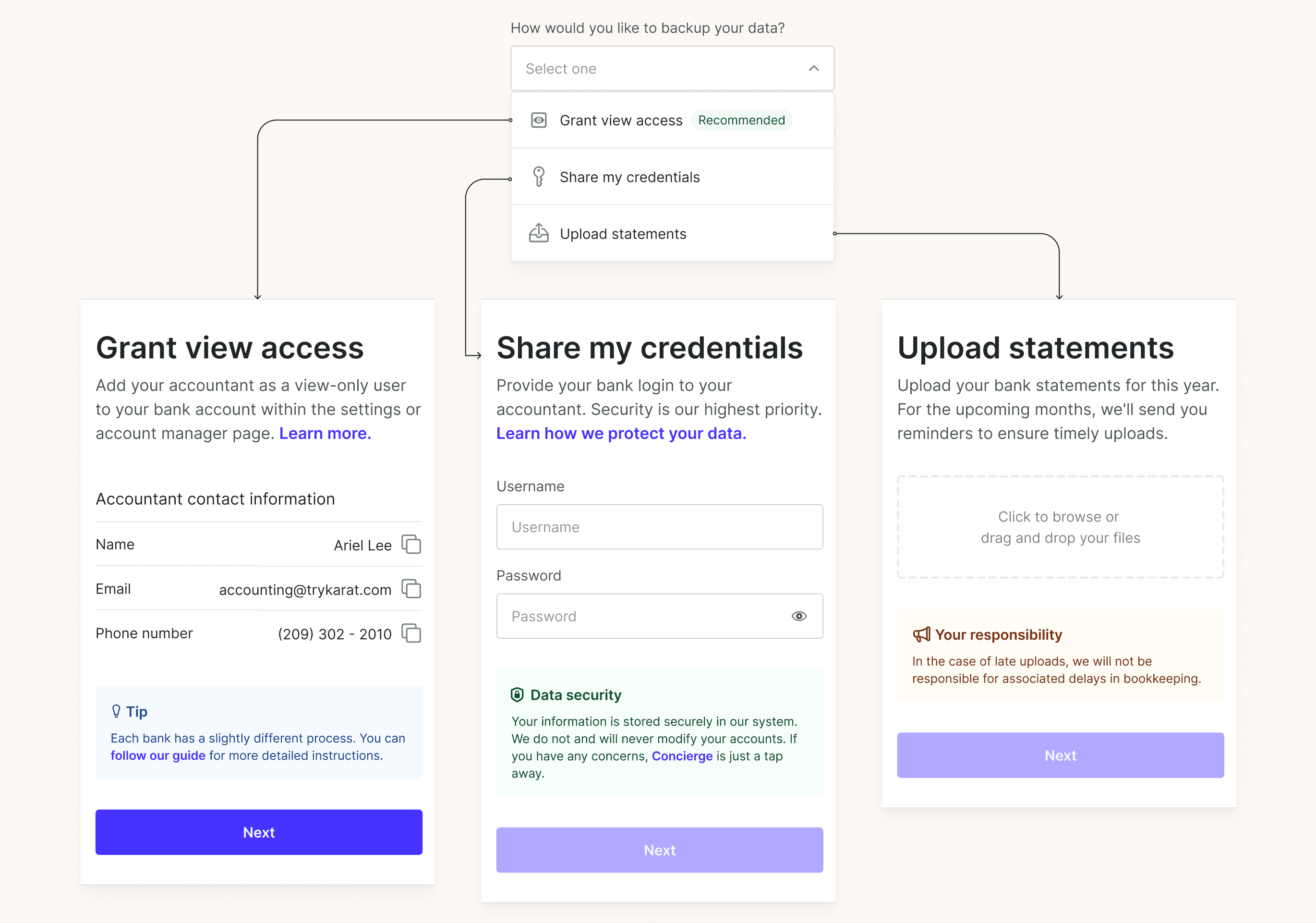
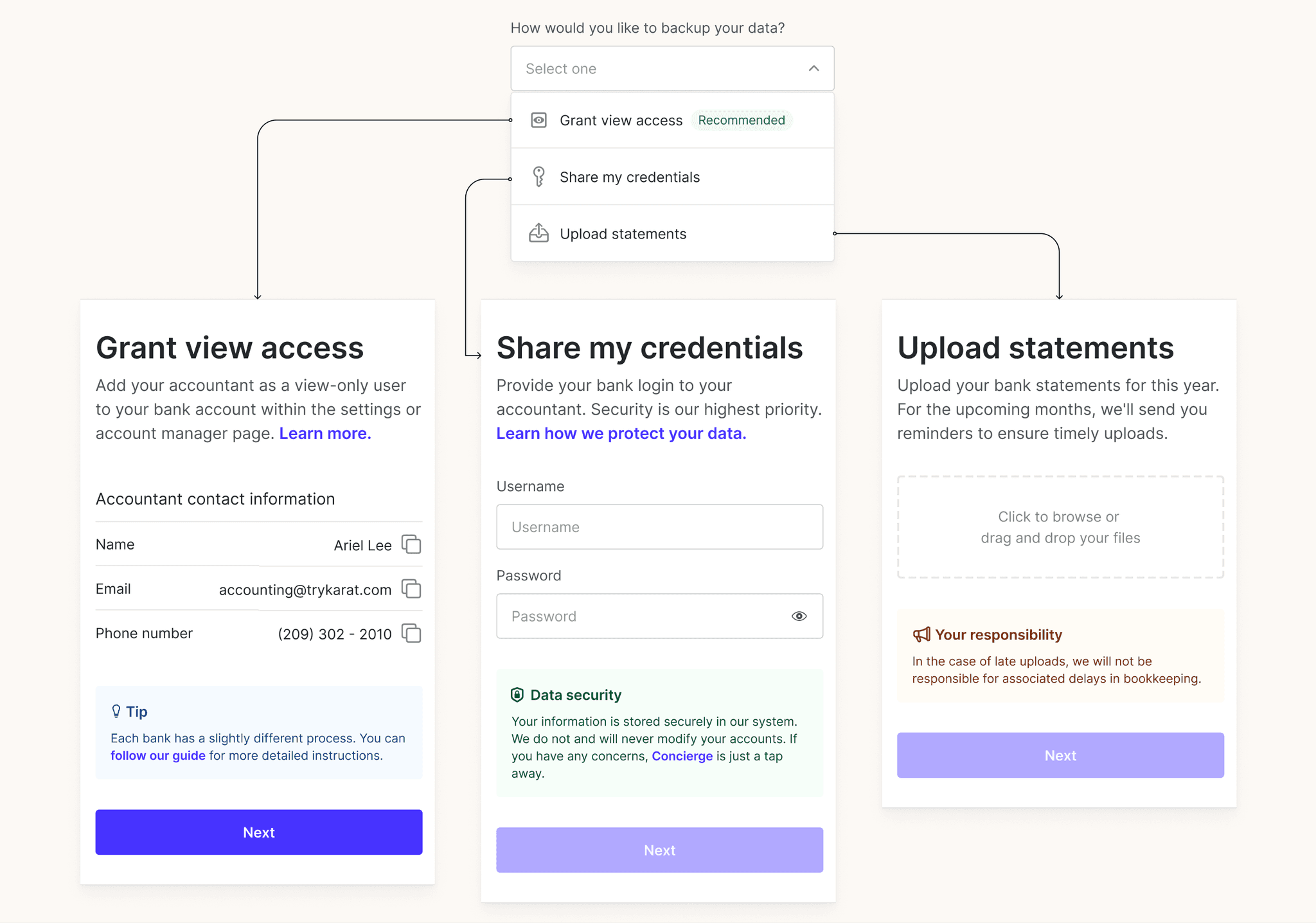
Customers could choose how to backup their financial data. We preferred view access and used a green badge to encourage that selection. On the flip side, uploading statement was the least preferred since it was the most manual method. We discouraged this option by using a yellow warning message to highlight potential delays.
Customers could choose how to backup their financial data. We preferred view access and used a green badge to encourage that selection. On the flip side, uploading statement was the least preferred since it was the most manual method. We discouraged this option by using a yellow warning message to highlight potential delays.
We had to create workarounds when we realized accessing real-time financial data was unreliable
Previously, we asked for bank statements from customer as part of the onboarding flow. We aimed to replace that with direct bank linking for real-time financial access. However, frequent outages caused issues. When it worked, it boosted accounting efficiency, but when it failed, it led to significant costs, doubling accountants' workload.
Now, as part of onboarding we request customers to provide a back up of their financials. This ensured that we would always be able to reconcile their finances in a timely and accurate way.
OUTCOME AND NEXT STEPS
After launch, we reduced the time spent facilitating onboarding by 30% and improved customer satisfaction.
In December 2022, we launched a comprehensive onboarding flow and customer management platform. Accountants saved 30% of their time tracking onboarding progress. Measuring customer time was tricky due to factors like vacations impacting onboarding durations, yet post-launch, we saw a significant reduction in complaints. The mobile-friendly approach made onboarding more convenient for our customers.
Our next step is to investigate how to make real-time financial access more reliable. This would then pave the way for us to automate the financial report preparation which is still manual to this day. As of Q4 2023, this project was put on an indefinite hold due to a shift in company direction.
After launch, we reduced the time spent facilitating onboarding by 30% and improved customer satisfaction.
In December 2022, we launched a comprehensive onboarding flow and customer management platform. Accountants saved 30% of their time tracking onboarding progress. Measuring customer time was tricky due to factors like vacations impacting onboarding durations, yet post-launch, we saw a significant reduction in complaints. The digitized and mobile-friendly approach made onboarding more convenient for our customers.
Our next step is to investigate how to make real-time financial access more reliable. This would then pave the way for us to automate the financial report preparation which is still manual to this day. As of Q4 2023, this project was put on an indefinite hold due to a shift in company direction.
OUTCOME AND NEXT STEPS
REFLECTIONS
It was challenging to launch a zero-to-one experience having to navigate shifting priorities and technical challenges. There were some important takeaways I wanted to highlight from this project:
Maintain a constant feedback loop
In the early days, we had high accountant turnover, which caused communication hiccups and led to us building a feature we didn't need. So, I started setting up regular check-ins and team meetings to keep us all on the same page. This not only helped us get in sync but also prevented us from scrapping late-stage work in the future.
Adapt quickly when operations change
We were building out the accounting practice and trying to scale it at the same time. This meant that processes kept changing which meant that the scope of the project was always changing. I had to adapt to those changes and still deliver the best design in time with tight deadlines.
Be opinionated on what we prioritize
During the discovery phase, there were many other processes we could’ve built a solution for. It was really important to advocate for what was a priority in order to maintain focus on solving the core problems, aka onboarding.
REFLECTIONS
It was challenging to launch a zero-to-one experience having to navigate shifting priorities and technical challenges. There were some important takeaways I wanted to highlight from this project:
Maintain a constant feedback loop
In the early days, there was a high turnover rate among accountants, which resulted in communication issues, ultimately leading to the development of a feature that wasn't needed. Learning from this, I began scheduling regular check-ins and initiated meetings to review our previous discussions to ensure everyone was aligned. This approach not only brought everyone onto the same page but also prevented late-stage work from being scrapped.
Adapt quickly when operations change
We were building out the accounting firm and trying to scale it at the same time. This meant that processes kept changing which meant that the scope of the project was always changing. I had to adapt to those changes and still deliver the best design in time with tight deadlines.
Be opinionated on what we prioritize
During the discovery phase, there were many other processes we could’ve built a solution for. It was really important to advocate for what was a priority in order to maintain focus on solving the core problems, aka onboarding.